On an electric car, a 12 V battery that keeps dying is a charging fault
Which produces a failure that catches almost everybody. When the converter stops charging properly — derated for temperature, or faulted outright — the 12 V battery is drained instead of filled. Lights dim, modules start reporting nonsense, and eventually the car will not power on at all. **It looks exactly like a dead 12 V battery, so a 12 V battery gets fitted, and the new one flattens too.** A perfectly healthy traction pack sits underneath the whole time.
**The measurement that settles it takes two minutes.** With the car powered on and ready to drive, put a meter across the 12 V battery terminals. You should see roughly 13.5 to 14.5 volts — the same as a running petrol car. **Twelve-point-something, with the car switched on, means it is not being charged**, and that is the converter's side of the fence rather than the battery's.
Two codes describe that side directly: P0C38 for the converter's temperature sensing, and P0CA2 for the step-down conversion underperforming. But you do not need a code to apply the rule.
The rule: on an electrified car, replace a 12 V battery once. **If the second one goes flat, stop buying batteries.**
Bijlagen
-
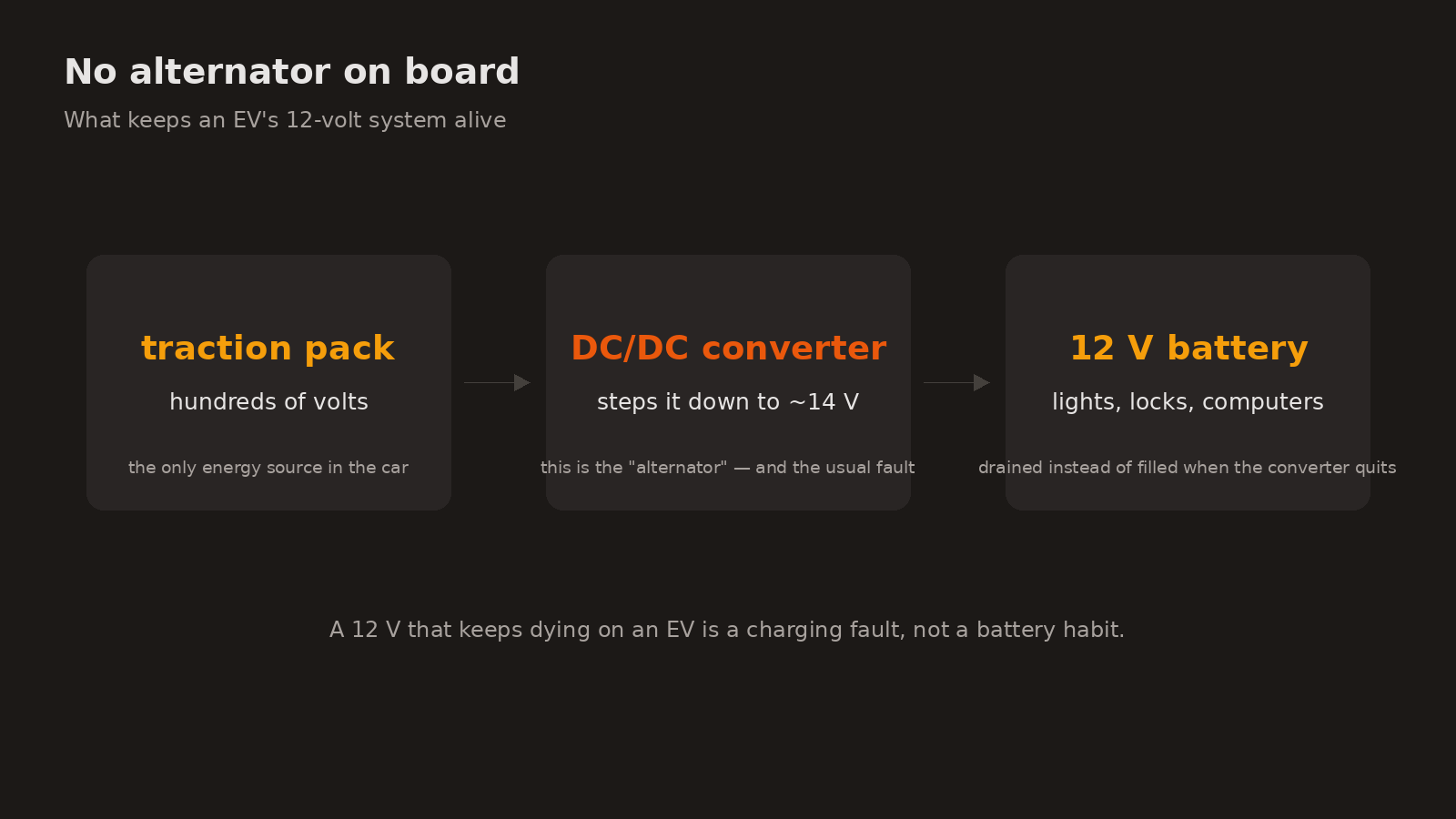
Diagram: the EV twelve-volt chain — traction pack to DC/DC converter to the small battery — and why a failing converter drains it.
Informatie, geen instructie
CarGeek is een naslagwerk, geen werkplaatshandboek. De pagina's zijn geschreven op basis van openbare bronnen en van wat anderen hebben ondervonden, nooit op basis van de servicedocumentatie van de fabrikant zelf, dus ze kunnen onjuist of onvolledig zijn voor jouw specifieke voertuig. Een deel van wat erin staat brengt echt gevaar met zich mee: hoogspanning, brandstof onder druk, opgeslagen energie en hete of bewegende delen.
Laat alles waarnaar je wilt handelen eerst controleren door iemand met een technische opleiding, aan de hand van de eigen procedure van de fabrikant voor jouw voertuig. Niets hier vervangt die procedure.