On an electric car, a 12 V battery that keeps dying is a charging fault
Which produces a failure that catches almost everybody. When the converter stops charging properly — derated for temperature, or faulted outright — the 12 V battery is drained instead of filled. Lights dim, modules start reporting nonsense, and eventually the car will not power on at all. **It looks exactly like a dead 12 V battery, so a 12 V battery gets fitted, and the new one flattens too.** A perfectly healthy traction pack sits underneath the whole time.
**The measurement that settles it takes two minutes.** With the car powered on and ready to drive, put a meter across the 12 V battery terminals. You should see roughly 13.5 to 14.5 volts — the same as a running petrol car. **Twelve-point-something, with the car switched on, means it is not being charged**, and that is the converter's side of the fence rather than the battery's.
Two codes describe that side directly: P0C38 for the converter's temperature sensing, and P0CA2 for the step-down conversion underperforming. But you do not need a code to apply the rule.
The rule: on an electrified car, replace a 12 V battery once. **If the second one goes flat, stop buying batteries.**
Pièces jointes
-
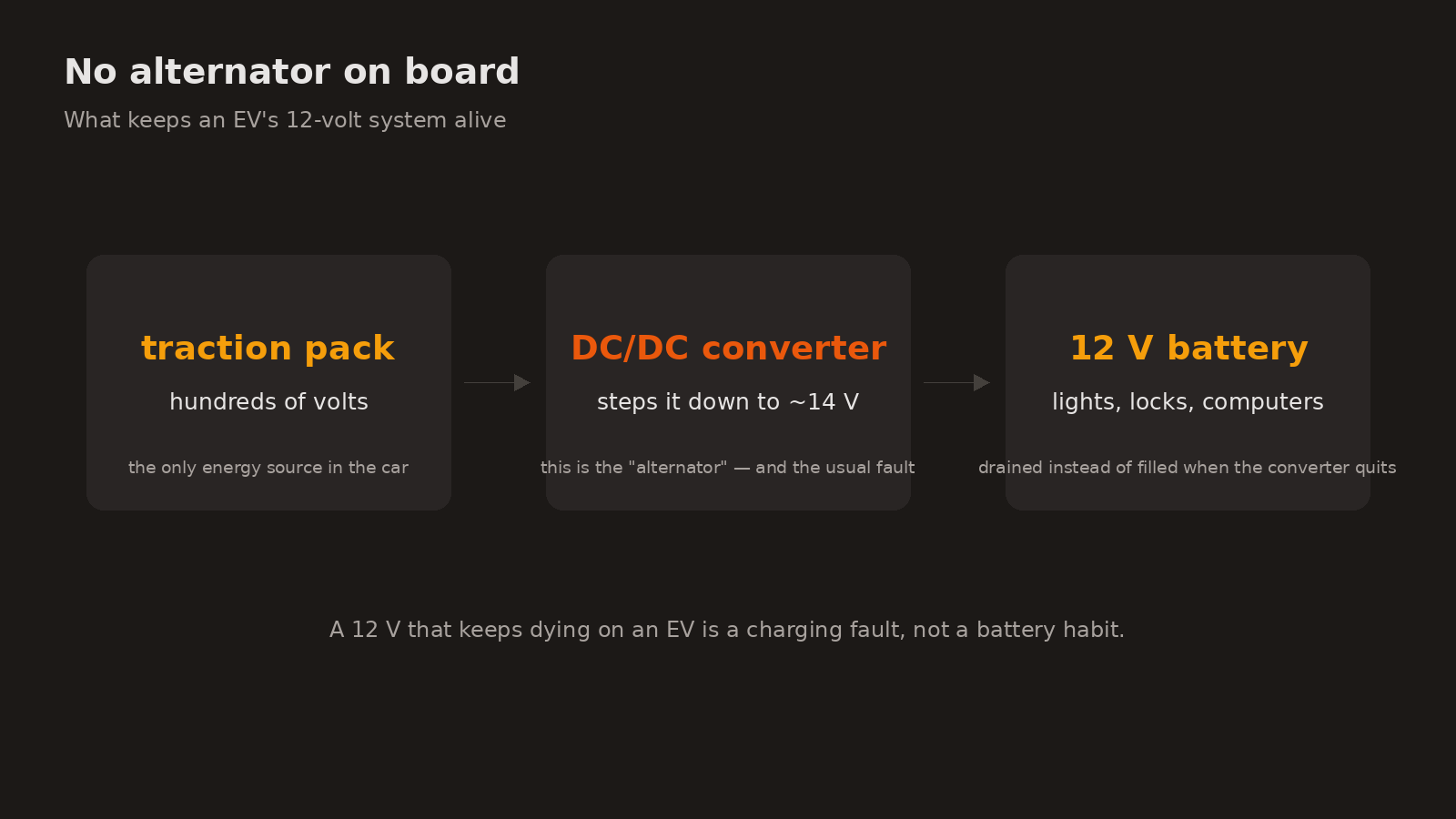
Diagram: the EV twelve-volt chain — traction pack to DC/DC converter to the small battery — and why a failing converter drains it.
Des informations, pas des instructions
CarGeek est un ouvrage de référence, pas un manuel d'atelier. Ses pages sont rédigées à partir de sources publiques et de ce que d'autres ont constaté, jamais à partir de la documentation technique du constructeur ; elles peuvent donc être erronées ou incomplètes pour votre véhicule précis. Une partie de ce qu'elles décrivent présente un risque réel : haute tension, carburant sous pression, énergie accumulée, pièces chaudes ou en mouvement.
Avant d'agir sur quoi que ce soit, faites-le vérifier par une personne formée, en suivant la procédure du constructeur pour votre véhicule. Rien ici ne remplace cette procédure.