Vehicle
Dodge Neon
Chrysler's compact of the nineties, sold as Dodge, Plymouth and — outside North America — Chrysler, all one car. The head gasket is the thing to know: early cars used a single-layer steel gasket that fails between the cylinders and the coolant passages, and the multi-layer replacement is the standard fix rather than an upgrade. The 2.0 is a chain-driven or belt-driven engine depending on head, and the SRT-4's turbocharged version shares little beyond the block with the ordinary car — different fuel system, different management, different clutch.

Generations
-
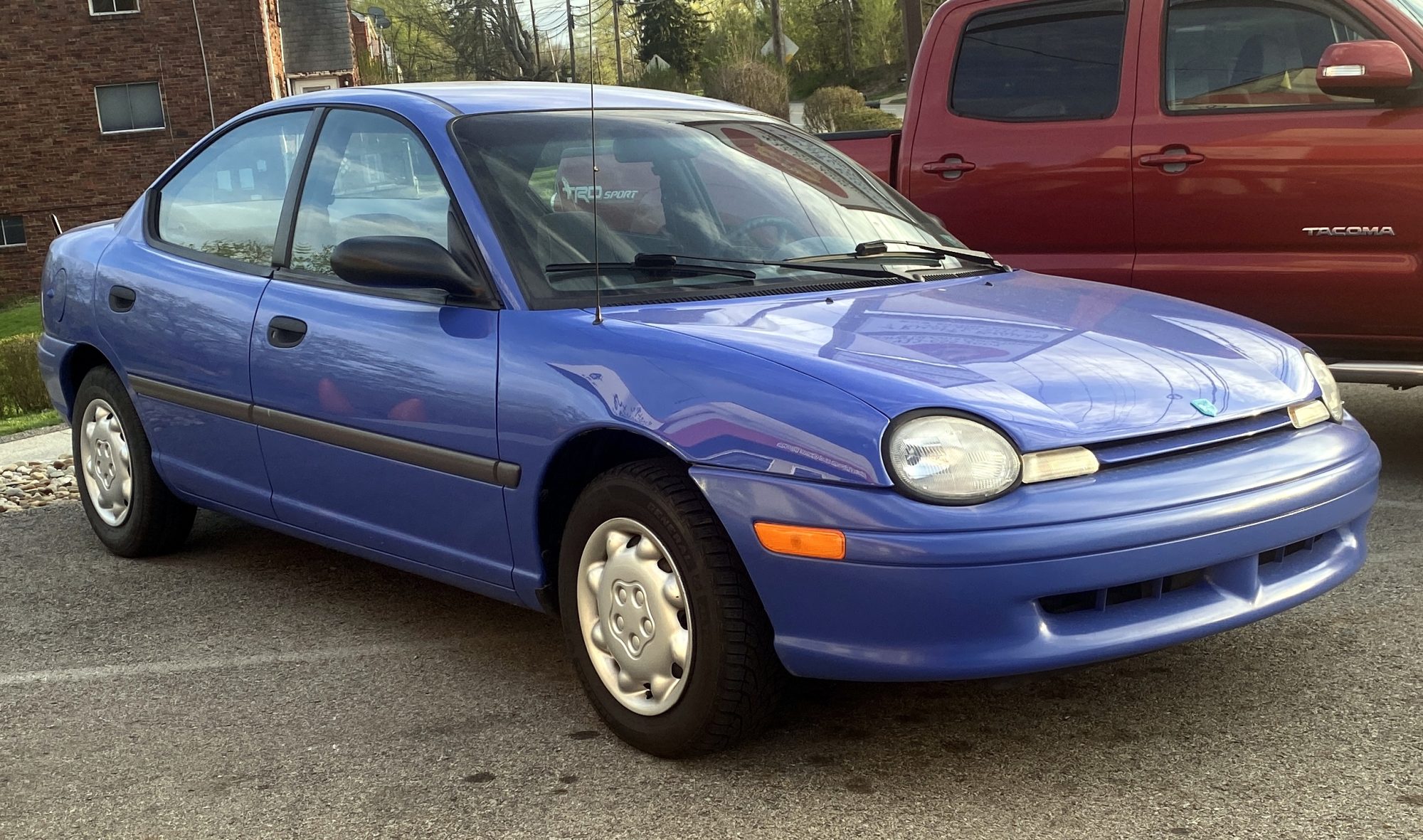
First generation 1994–1999
One body, two badges, and no separate Chrysler name in North America. The 2.0 DOHC is the enthusiast engine; the SOHC is the volume one.
- Body styles
- Sedan · Coupé
- Platform
- Chrysler PL
- Engines
-
- 1.8 four-cylinder — petrol · Europe
- 2.0 SOHC — ECB · petrol · 98 kW (132 hp)
- 2.0 DOHC — ECC · petrol · 112 kW (150 hp)
- Transmissions
- 5-speed NVG T-350 manual · 3-speed TorqueFlite 31TH automatic
- Drivetrain
- Front-wheel drive
-
Second generation 1999–2005
Sold as Dodge SX 2.0 in Canada. The SRT-4 of 2003 is a genuinely different car under the badge — turbocharged, with its own gearbox and brakes.
- A404 / A413 / A470 / 31TH 3-speed automatic
- New Venture T-350 5-speed manual
- Ultradrive (41TE / 62TE) automatic
- Body styles
- Sedan
- Platform
- Chrysler PL
- Engines
-
- 2.0 SOHC — ECN · petrol · 98 kW (132 hp)
- 2.4 turbo — EDV · petrol · 160–172 kW (215–230 hp) · SRT-4
- 1.6 — petrol
- Transmissions
- 5-speed NVG T-350 manual · 3-speed TorqueFlite 31TH automatic · 4-speed Ultradrive 40TE automatic · 4-speed Ultradrive 41TE automatic
- Drivetrain
- Front-wheel drive
Information, not instruction
CarGeek is a reference, not a service manual. Its pages are written from public sources and from what other people have found, never from a manufacturer's own service information, so they can be wrong or incomplete for your particular vehicle. Some of what they describe carries real risk: high voltage, fuel under pressure, stored energy, hot and moving parts.
Have anything you intend to act on checked by a trained person against the manufacturer's own procedure for your vehicle. Nothing here replaces that procedure.
Posted about the Dodge Neon
Be the first to write this up
Nothing posted about this yet. Whatever you found is worth writing down — even a dead end saves someone the same afternoon.
What makes one worth reading:
- The car — make, model, year and engine. The same fault behaves differently on each.
- What you measured, not only what you replaced.
- What actually fixed it — or that nothing did, which is worth knowing too.
Sign in or create an account to add what you found about Dodge Neon.