Vehicle
Hyundai Azera
Hyundai's full-size front-drive saloon, sold in North America as XG300 and XG350 before the Azera name arrived in 2006 and as Grandeur everywhere else — one nameplate under three badges, and the year decides which car you are standing in front of. The XG is a Sigma or Delta V6 with a conventional port-injected fuel system; the TG and HG move to Lambda V6 and Theta II four-cylinder engines, and from 2011 to direct injection, which changes what a lean or misfire code means and puts carbon on the intake valves that a port-injected engine never accumulates. The 2.4 Theta II here is the same engine family as the Sonata's, so its connecting-rod bearing history and the knock-sensor detection system retrofitted for it apply to this car too.
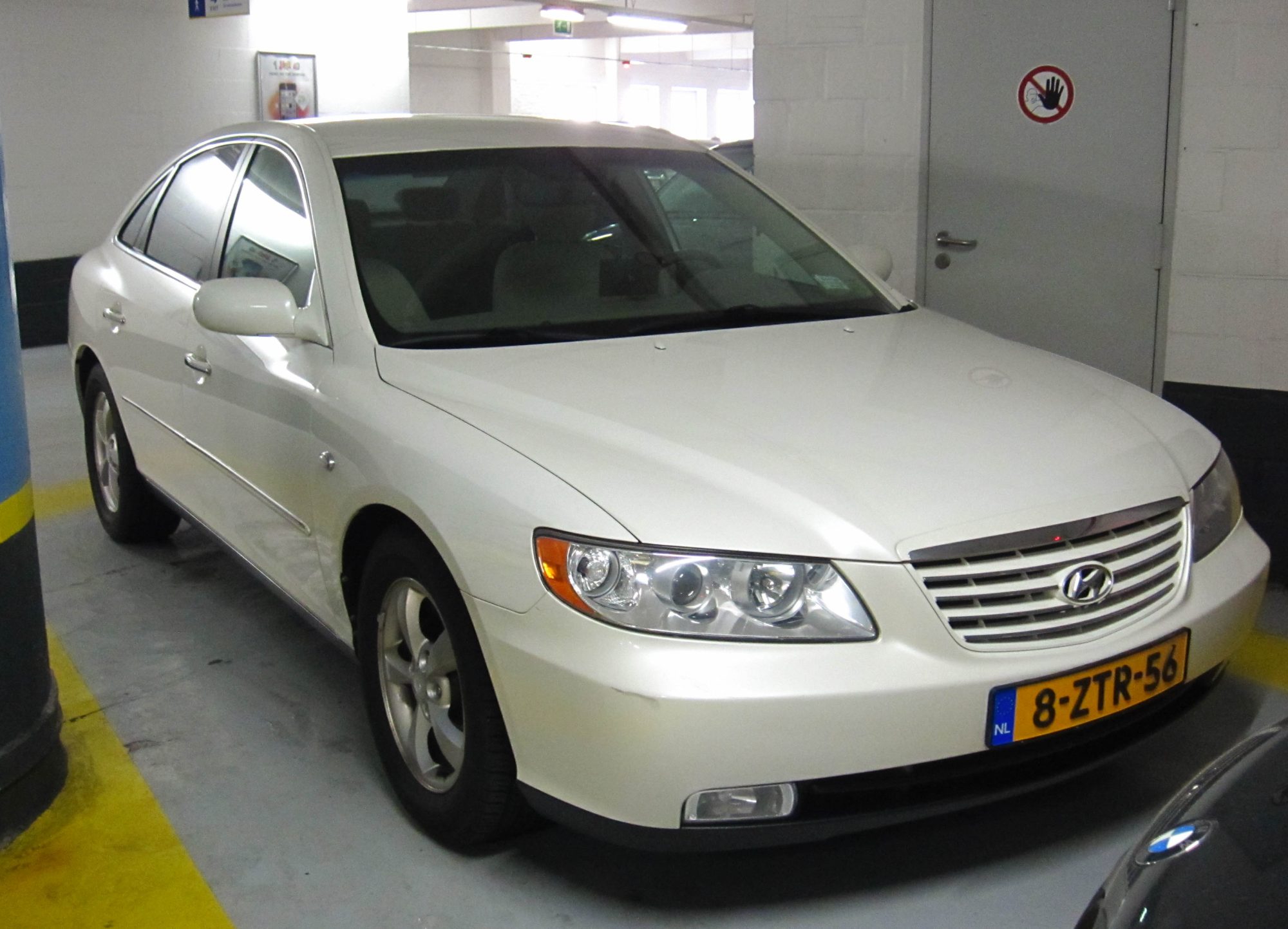
.jpg)
Generations
-
XG 1998–2005
Sold in America as XG300 and XG350. Port-injected Sigma and Delta V6s with a Mitsubishi-derived four-speed automatic — mechanically the simplest car on this page.
- Body styles
- Sedan
- Platform
- Hyundai XG
- Engines
-
- 2.0 V6 — petrol · Delta, Korea
- 2.5 V6 — petrol · Delta, XG250
- 2.7 V6 — petrol · Delta
- 3.0 V6 — petrol · Sigma, XG300
- 3.5 V6 — petrol · Sigma, XG350
- Transmissions
- 4-speed automatic · 5-speed automatic · 5-speed manual
- Drivetrain
- Front-wheel drive
-
TG 2005–2011
First car to carry the Azera name in North America. Lambda V6 and the 2.2 CRDi diesel elsewhere; still port injection throughout.
- Body styles
- Sedan
- Platform
- Hyundai TG
- Engines
-
- 2.4 Theta II — G4KE · petrol
- 2.7 V6 — petrol · Mu
- 3.3 V6 — petrol · 174 kW (234 hp) · Lambda
- 3.8 V6 — petrol · 196 kW (263 hp) · Lambda
- 2.2 CRDi — D4EB · diesel
- Transmissions
- 5-speed automatic · 6-speed automatic
- Drivetrain
- Front-wheel drive
-
HG 2011–2017
Direct injection arrives on the Lambda II V6 and the Theta II four, and a hybrid joins in 2013 — so a lean-bank or misfire code on this generation wants the carbon question asked before the sensor is replaced.
- Body styles
- Sedan
- Platform
- Hyundai Y6
- Engines
-
- 2.4 Theta II GDi — G4KJ · petrol · 132 kW (177 hp) · 231 Nm (170 lb-ft)
- 3.0 Lambda II GDi V6 — G6DG · petrol
- 3.3 Lambda II GDi V6 — G6DH · petrol · 216 kW (290 hp) · 346 Nm (255 lb-ft)
- 2.4 II hybrid — THETA · hybrid
- 2.2 R II CRDi — D4HB · diesel
- Transmissions
- 6-speed automatic · 8-speed automatic
- Drivetrain
- Front-wheel drive
-
IG 2016–2022
Grandeur only outside Korea's export markets by the end; the 2019 facelift moves to Smartstream engines and the N platform, so a 2020 car shares little of its running gear with a 2017 one.
- Body styles
- Sedan
- Platform
- Hyundai Y7 and N
- Engines
-
- 2.4 Theta II GDi — G4KJ · petrol · 140 kW (188 hp) · 241 Nm (178 lb-ft)
- 2.5 Smartstream GDi — G4KP · petrol · 146 kW (196 hp) · 248 Nm (183 lb-ft) · 2019 facelift
- 3.0 Lambda II V6 — G6DG · petrol
- 3.3 Lambda II GDi V6 — G6DH · petrol
- 3.5 II MPi V6 — LAMBDA · petrol · 213 kW (286 hp) · 338 Nm (249 lb-ft)
- 2.4 II hybrid — THETA · hybrid
- 3.0 II LPi V6 — LAMBDA · LPG bi-fuel · Korea
- 2.2 R II CRDi — D4HB · diesel
- Transmissions
- 6-speed automatic · 8-speed automatic
- Drivetrain
- Front-wheel drive
Service information
Information, not instruction
CarGeek is a reference, not a service manual. Its pages are written from public sources and from what other people have found, never from a manufacturer's own service information, so they can be wrong or incomplete for your particular vehicle. Some of what they describe carries real risk: high voltage, fuel under pressure, stored energy, hot and moving parts.
Have anything you intend to act on checked by a trained person against the manufacturer's own procedure for your vehicle. Nothing here replaces that procedure.
Posted about the Hyundai Azera
Be the first to write this up
Nothing posted about this yet. Whatever you found is worth writing down — even a dead end saves someone the same afternoon.
What makes one worth reading:
- The car — make, model, year and engine. The same fault behaves differently on each.
- What you measured, not only what you replaced.
- What actually fixed it — or that nothing did, which is worth knowing too.
Sign in or create an account to add what you found about Hyundai Azera.