Vehicle
Kia Sephia
Kia's own compact, and the model whose name history most often sends a diagnosis to the wrong car. It was sold as Sephia, Mentor and Shuma depending on market, and in North America the second-generation liftback took the name Spectra in 2000 — but from 2005 the Spectra badge moved onto the entirely different first-generation Cerato, which is a Hyundai-platform car with none of this one's parts. So a "Kia Spectra" is this car up to 2004 and a Cerato afterwards. Mechanically the early cars are Mazda underneath — the B-series engines and much of the transaxle are Mazda's — which is where their documentation is.

Generations
-
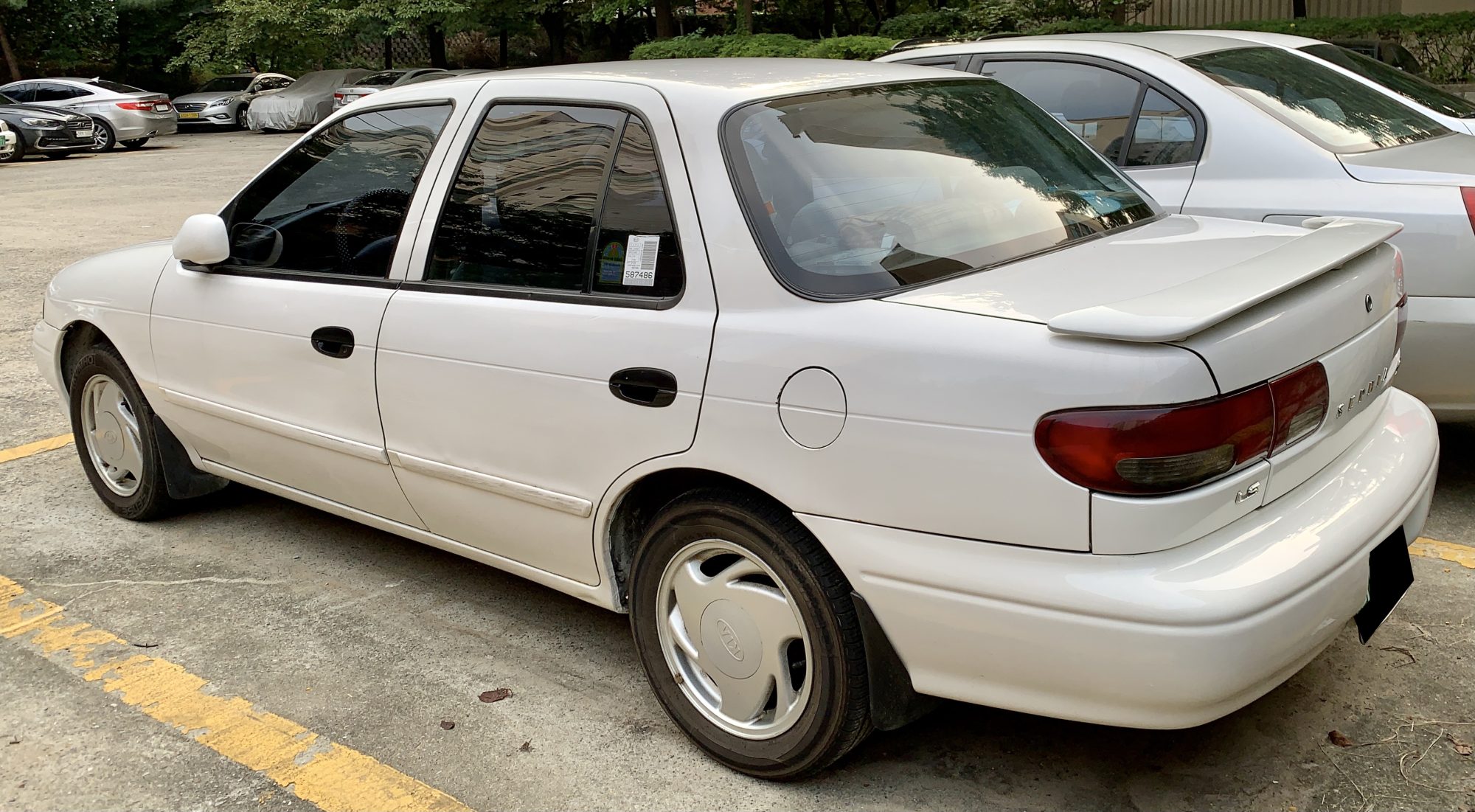
First generation 1992–1997
Kia's first self-designed chassis, on Mazda B-series engines. Sold as Mentor in much of the world and as Timor in Indonesia.
- Body styles
- Sedan
- Platform
- Mazda B
- Engines
-
- 1.5 four-cylinder — petrol · Mazda B-series engine code B5
- 1.6 four-cylinder — B6-DE · petrol · Mazda
- 1.8 four-cylinder — BP-ZE · petrol · Mazda
- Transmissions
- 5-speed manual · 4-speed F4A-EL automatic
- Drivetrain
- Front-wheel drive
-
Second generation 1997–2004
Sold as Sephia, Mentor, Shuma and — in North America from 2000 — Spectra. Kia's own 1.8 T8D joins the Mazda engines.
- Body styles
- Sedan · Hatchback
- Platform
- Kia Sephia II
- Engines
-
- 1.5 four-cylinder — petrol · Mazda B-series engine code B5
- 1.6 four-cylinder — petrol · Mazda B-series engine code B6
- 1.8 four-cylinder — T8D · petrol · 93 kW (125 hp)
- Transmissions
- 4-speed F4A-EL automatic · 5-speed G5M manual
- Drivetrain
- Front-wheel drive
Service information
Information, not instruction
CarGeek is a reference, not a service manual. Its pages are written from public sources and from what other people have found, never from a manufacturer's own service information, so they can be wrong or incomplete for your particular vehicle. Some of what they describe carries real risk: high voltage, fuel under pressure, stored energy, hot and moving parts.
Have anything you intend to act on checked by a trained person against the manufacturer's own procedure for your vehicle. Nothing here replaces that procedure.
Posted about the Kia Sephia
Be the first to write this up
Nothing posted about this yet. Whatever you found is worth writing down — even a dead end saves someone the same afternoon.
What makes one worth reading:
- The car — make, model, year and engine. The same fault behaves differently on each.
- What you measured, not only what you replaced.
- What actually fixed it — or that nothing did, which is worth knowing too.
Sign in or create an account to add what you found about Kia Sephia.