Vehicle
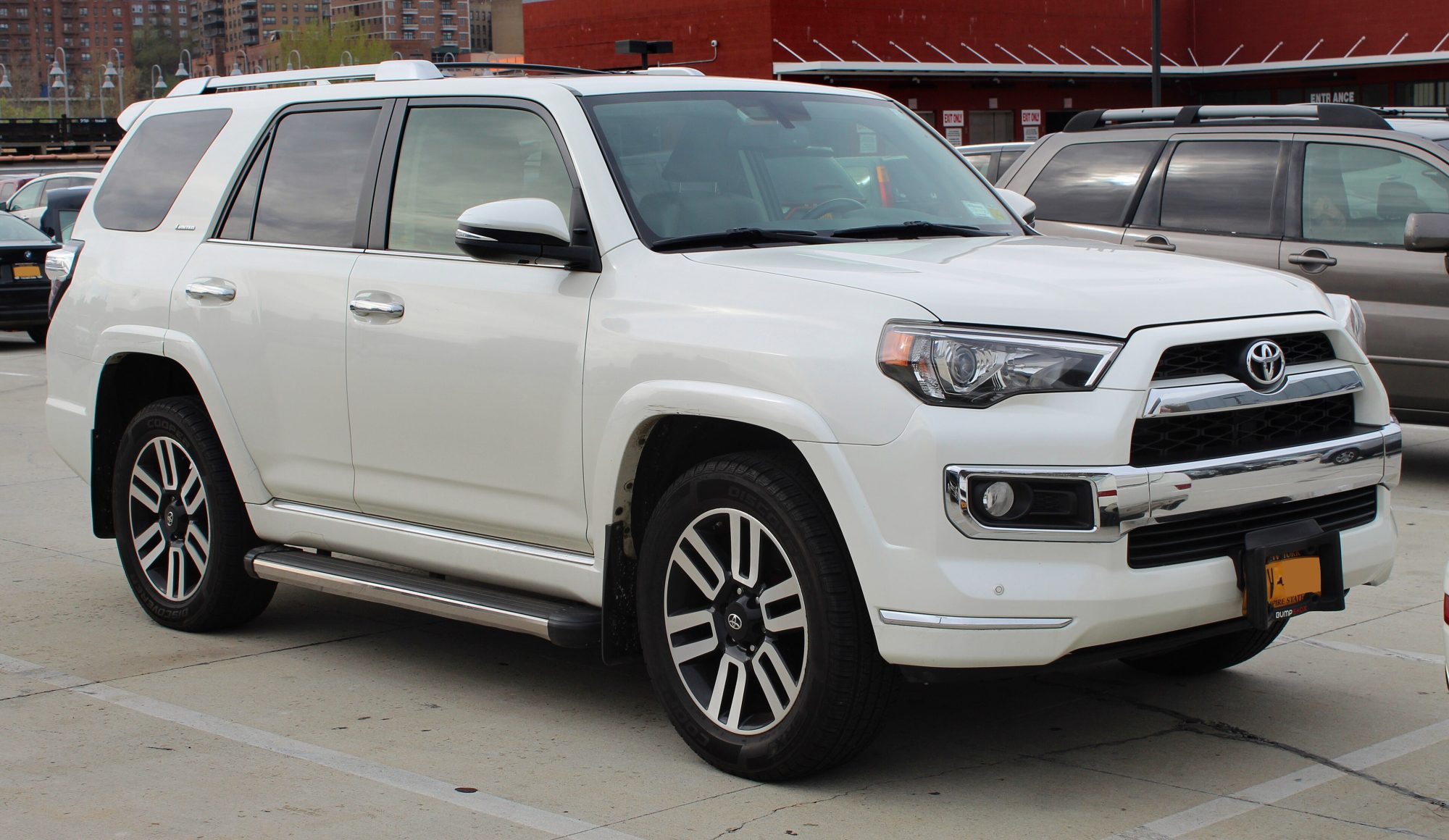
Toyota 4Runner
The body-on-frame SUV, sold in Japan as the Hilux Surf — search both names, because the Japanese-market Surf carries a diesel the North American 4Runner never had. The fifth generation ran essentially unchanged from 2009 to 2024 on one engine, which makes it unusually well understood: almost every fault on one has been seen many times. Four-wheel-drive versions split between part-time and full-time systems with a locking centre differential, and which one a car has changes what a driveline code means.
_4.20.19.jpg)
Generations
-
First generation (N60) 1984–1989
A short-bed Hilux with the cab rear wall removed and a bolt-on fibreglass top; mechanically it is the pickup. The 2.4 petrol runs either the carburetted 22R or the injected 22R-E, and which one a car has decides every fuel-system diagnosis on it.
- Body styles
- SUV
- Platform
- Toyota Hilux
- Engines
-
- 2.0 — 3Y-EU · petrol
- 2.2 — 4Y-C · petrol
- 2.4 carburettor — 22R · petrol · 174–190 Nm (128–140 lb-ft)
- 2.4 four-cylinder — 22R-E · petrol · 78–84 kW (105–113 hp) · 185–190 Nm (136–140 lb-ft)
- 2.4 turbo — 22R-TE · petrol · 101 kW (135 hp) · 234 Nm (173 lb-ft)
- 3.0 V6 — 3VZ-E · petrol · 244–245 Nm (180–181 lb-ft) · from 1988
- 2.4 — 2L · diesel · 1984–1989
- 2.4 turbo diesel — 2L-T · diesel · 1985–1989
- Transmissions
- 5-speed manual · 4-speed automatic
- Drivetrain
- Rear-wheel drive · Part-time four-wheel drive with low range
-
Second generation (N120/N130) 1989–1995
A full steel body on the Hilux frame rather than a cap on a pickup bed, and the first five-door. The 3VZ-E V6 of these years has a well-known head-gasket history the later 5VZ does not, and the Japanese-market 1KZ diesels were never sold where the North American car went.
- Body styles
- SUV
- Platform
- Toyota Hilux
- Engines
-
- 2.0 — petrol · YN130G, 1989–1991
- 2.2 — 4Y · petrol
- 2.4 four-cylinder — 22R-E · petrol · 78–84 kW (105–113 hp) · 185–190 Nm (136–140 lb-ft)
- 3.0 V6 — 3VZ-E · petrol · 244–245 Nm (180–181 lb-ft)
- 2.4 turbo diesel — 2L-TE · diesel · 71–72 kW (95–97 hp) · 221–241 Nm (163–178 lb-ft) · LN130G and LN130W
- 2.8 — 3L · diesel · 64–68 kW (86–91 hp) · 188 Nm (139 lb-ft) · LN131V
- 3.0 turbo diesel — 1KZ-T · diesel · 92 kW (123 hp) · 287–296 Nm (212–218 lb-ft) · KZN130; mechanical injection pump
- 3.0 turbo diesel — 1KZ-TE · diesel · 95 kW (127 hp) · 287–289 Nm (212–213 lb-ft) · KZN130; from 1993
- Transmissions
- 5-speed manual · 4-speed A340H automatic
- Drivetrain
- Rear-wheel drive · Part-time four-wheel drive with low range
-
Third generation (N180) 1995–2002
An all-new body on an all-new chassis, sharing engines and gearboxes with the Tacoma and its frame with the Land Cruiser Prado. The 5VZ-FE leaves the 3VZ-E head-gasket reputation behind, and in Japan the indirect-injection 1KZ-TE gives way to the common-rail 1KD-FTV in 2000.
- Body styles
- SUV
- Platform
- Toyota Hilux
- Engines
-
- 2.7 — 3RZ-FE · petrol · 223–240 Nm (164–177 lb-ft) · 4-cylinder; Japan 1995–2002, North America 1996–2000
- 3.4 V6 — 5VZ-FE · petrol · 132–142 kW (177–190 hp) · 294–299 Nm (217–221 lb-ft)
- 3.0 turbo diesel — 1KZ-TE · diesel · 95 kW (127 hp) · 287–289 Nm (212–213 lb-ft) · KZN185; Japan, 1995–2000
- 3.0 turbo — 1KD-FTV · diesel · 100–140 kW (134–188 hp) · 280–420 Nm (207–310 lb-ft) · KDN185; Japan, 2000–2002
- Transmissions
- 5-speed manual · 4-speed A340F automatic
- Drivetrain
- Rear-wheel drive · Part-time four-wheel drive with low range
-
Fourth generation 2002–2009
The V8 era, and the generation where the air suspension on higher trims becomes its own fault population.
- Body styles
- SUV
- Platform
- Toyota N
- Engines
-
- 4.0 V6 — 1GR-FE · petrol · 177–199 kW (237–267 hp) · 361–380 Nm (266–280 lb-ft)
- 4.7 V8 — 2UZ-FE · petrol · 170–212 kW (228–284 hp) · 410–448 Nm (302–330 lb-ft)
- 2.7 — 3RZ-FE · petrol · 223–240 Nm (164–177 lb-ft) · RZN210/215; Japan, 2002–2004
- 2.7 — 2TR-FE · petrol · 241–246 Nm (178–181 lb-ft) · TRN210/215; Japan, 2004–2009
- 3.4 V6 — 5VZ-FE · petrol · 132–142 kW (177–190 hp) · 294–299 Nm (217–221 lb-ft) · VZN210/215; Japan, 2002–2005
- 3.0 turbo — 1KD-FTV · diesel · 100–140 kW (134–188 hp) · 280–420 Nm (207–310 lb-ft) · KDN215; Japan, 2002–2005
- Transmissions
- 4-speed automatic · 5-speed automatic · 4-speed A3xx automatic · 5-speed A7xx automatic
- Drivetrain
- Rear-wheel drive · Part-time four-wheel drive with low range
-
Fifth generation 2009–2024
Fifteen years on one engine — the fault population is small and thoroughly documented, which is rare.
- Body styles
- SUV
- Platform
- Toyota N
- Engines
-
- 4.0 V6 — 1GR-FE · petrol · 177–199 kW (237–267 hp) · 361–380 Nm (266–280 lb-ft)
- 2.7 — 2TR-FE · petrol · 241–246 Nm (178–181 lb-ft) · TRN280; 2009–2010
- Transmissions
- 5-speed automatic · 4-speed automatic
- Drivetrain
- Rear-wheel drive · Part-time four-wheel drive with low range
Service information
Information, not instruction
CarGeek is a reference, not a service manual. Its pages are written from public sources and from what other people have found, never from a manufacturer's own service information, so they can be wrong or incomplete for your particular vehicle. Some of what they describe carries real risk: high voltage, fuel under pressure, stored energy, hot and moving parts.
Have anything you intend to act on checked by a trained person against the manufacturer's own procedure for your vehicle. Nothing here replaces that procedure.
Posted about the Toyota 4Runner
Be the first to write this up
Nothing posted about this yet. Whatever you found is worth writing down — even a dead end saves someone the same afternoon.
What makes one worth reading:
- The car — make, model, year and engine. The same fault behaves differently on each.
- What you measured, not only what you replaced.
- What actually fixed it — or that nothing did, which is worth knowing too.
Sign in or create an account to add what you found about Toyota 4Runner.