Véhicule
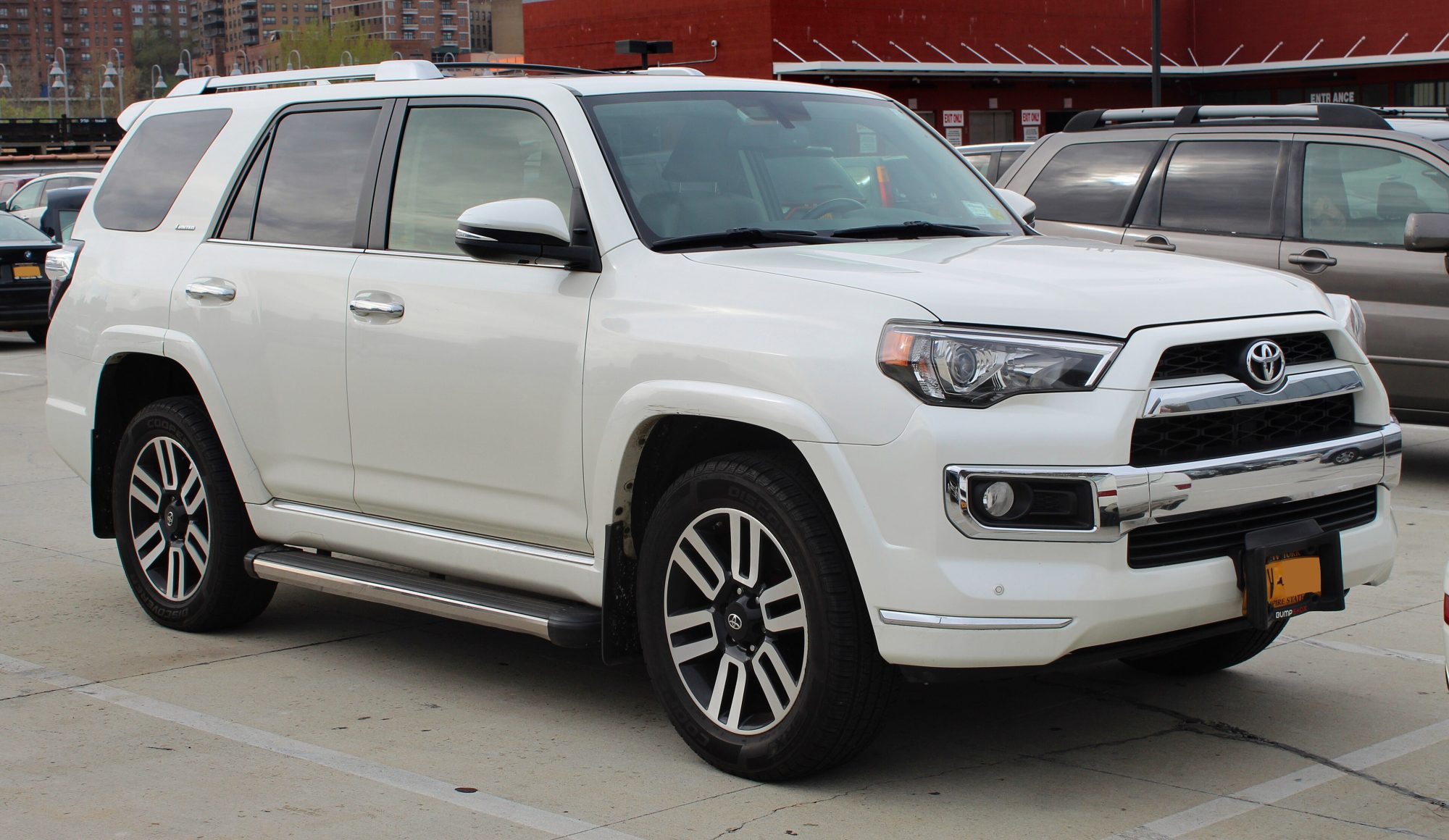
Toyota 4Runner
The body-on-frame SUV, sold in Japan as the Hilux Surf — search both names, because the Japanese-market Surf carries a diesel the North American 4Runner never had. The fifth generation ran essentially unchanged from 2009 to 2024 on one engine, which makes it unusually well understood: almost every fault on one has been seen many times. Four-wheel-drive versions split between part-time and full-time systems with a locking centre differential, and which one a car has changes what a driveline code means.
_4.20.19.jpg)
Générations
-
First generation (N60) 1984–1989
A short-bed Hilux with the cab rear wall removed and a bolt-on fibreglass top; mechanically it is the pickup. The 2.4 petrol runs either the carburetted 22R or the injected 22R-E, and which one a car has decides every fuel-system diagnosis on it.
- Types de carrosserie
- SUV
- Plateforme
- Toyota Hilux
- Moteurs
-
- 2.0 — 3Y-EU · petrol
- 2.2 — 4Y-C · petrol
- 2.4 carburettor — 22R · petrol · 174–190 Nm (128–140 lb-ft)
- 2.4 four-cylinder — 22R-E · petrol · 78–84 kW (105–113 hp) · 185–190 Nm (136–140 lb-ft)
- 2.4 turbo — 22R-TE · petrol · 101 kW (135 hp) · 234 Nm (173 lb-ft)
- 3.0 V6 — 3VZ-E · petrol · 244–245 Nm (180–181 lb-ft) · from 1988
- 2.4 — 2L · diesel · 1984–1989
- 2.4 turbo diesel — 2L-T · diesel · 1985–1989
- Boîtes de vitesses
- 5-speed manual · 4-speed automatic
- Transmission
- Rear-wheel drive · Part-time four-wheel drive with low range
-
Second generation (N120/N130) 1989–1995
A full steel body on the Hilux frame rather than a cap on a pickup bed, and the first five-door. The 3VZ-E V6 of these years has a well-known head-gasket history the later 5VZ does not, and the Japanese-market 1KZ diesels were never sold where the North American car went.
- Types de carrosserie
- SUV
- Plateforme
- Toyota Hilux
- Moteurs
-
- 2.0 — petrol · YN130G, 1989–1991
- 2.2 — 4Y · petrol
- 2.4 four-cylinder — 22R-E · petrol · 78–84 kW (105–113 hp) · 185–190 Nm (136–140 lb-ft)
- 3.0 V6 — 3VZ-E · petrol · 244–245 Nm (180–181 lb-ft)
- 2.4 turbo diesel — 2L-TE · diesel · 71–72 kW (95–97 hp) · 221–241 Nm (163–178 lb-ft) · LN130G and LN130W
- 2.8 — 3L · diesel · 64–68 kW (86–91 hp) · 188 Nm (139 lb-ft) · LN131V
- 3.0 turbo diesel — 1KZ-T · diesel · 92 kW (123 hp) · 287–296 Nm (212–218 lb-ft) · KZN130; mechanical injection pump
- 3.0 turbo diesel — 1KZ-TE · diesel · 95 kW (127 hp) · 287–289 Nm (212–213 lb-ft) · KZN130; from 1993
- Boîtes de vitesses
- 5-speed manual · 4-speed A340H automatic
- Transmission
- Rear-wheel drive · Part-time four-wheel drive with low range
-
Third generation (N180) 1995–2002
An all-new body on an all-new chassis, sharing engines and gearboxes with the Tacoma and its frame with the Land Cruiser Prado. The 5VZ-FE leaves the 3VZ-E head-gasket reputation behind, and in Japan the indirect-injection 1KZ-TE gives way to the common-rail 1KD-FTV in 2000.
- Types de carrosserie
- SUV
- Plateforme
- Toyota Hilux
- Moteurs
-
- 2.7 — 3RZ-FE · petrol · 223–240 Nm (164–177 lb-ft) · 4-cylinder; Japan 1995–2002, North America 1996–2000
- 3.4 V6 — 5VZ-FE · petrol · 132–142 kW (177–190 hp) · 294–299 Nm (217–221 lb-ft)
- 3.0 turbo diesel — 1KZ-TE · diesel · 95 kW (127 hp) · 287–289 Nm (212–213 lb-ft) · KZN185; Japan, 1995–2000
- 3.0 turbo — 1KD-FTV · diesel · 100–140 kW (134–188 hp) · 280–420 Nm (207–310 lb-ft) · KDN185; Japan, 2000–2002
- Boîtes de vitesses
- 5-speed manual · 4-speed A340F automatic
- Transmission
- Rear-wheel drive · Part-time four-wheel drive with low range
-
Fourth generation 2002–2009
The V8 era, and the generation where the air suspension on higher trims becomes its own fault population.
- Types de carrosserie
- SUV
- Plateforme
- Toyota N
- Moteurs
-
- 4.0 V6 — 1GR-FE · petrol · 177–199 kW (237–267 hp) · 361–380 Nm (266–280 lb-ft)
- 4.7 V8 — 2UZ-FE · petrol · 170–212 kW (228–284 hp) · 410–448 Nm (302–330 lb-ft)
- 2.7 — 3RZ-FE · petrol · 223–240 Nm (164–177 lb-ft) · RZN210/215; Japan, 2002–2004
- 2.7 — 2TR-FE · petrol · 241–246 Nm (178–181 lb-ft) · TRN210/215; Japan, 2004–2009
- 3.4 V6 — 5VZ-FE · petrol · 132–142 kW (177–190 hp) · 294–299 Nm (217–221 lb-ft) · VZN210/215; Japan, 2002–2005
- 3.0 turbo — 1KD-FTV · diesel · 100–140 kW (134–188 hp) · 280–420 Nm (207–310 lb-ft) · KDN215; Japan, 2002–2005
- Boîtes de vitesses
- 4-speed automatic · 5-speed automatic · 4-speed A3xx automatic · 5-speed A7xx automatic
- Transmission
- Rear-wheel drive · Part-time four-wheel drive with low range
-
Fifth generation 2009–2024
Fifteen years on one engine — the fault population is small and thoroughly documented, which is rare.
- Types de carrosserie
- SUV
- Plateforme
- Toyota N
- Moteurs
-
- 4.0 V6 — 1GR-FE · petrol · 177–199 kW (237–267 hp) · 361–380 Nm (266–280 lb-ft)
- 2.7 — 2TR-FE · petrol · 241–246 Nm (178–181 lb-ft) · TRN280; 2009–2010
- Boîtes de vitesses
- 5-speed automatic · 4-speed automatic
- Transmission
- Rear-wheel drive · Part-time four-wheel drive with low range
Informations de service
Des informations, pas des instructions
CarGeek est un ouvrage de référence, pas un manuel d'atelier. Ses pages sont rédigées à partir de sources publiques et de ce que d'autres ont constaté, jamais à partir de la documentation technique du constructeur ; elles peuvent donc être erronées ou incomplètes pour votre véhicule précis. Une partie de ce qu'elles décrivent présente un risque réel : haute tension, carburant sous pression, énergie accumulée, pièces chaudes ou en mouvement.
Avant d'agir sur quoi que ce soit, faites-le vérifier par une personne formée, en suivant la procédure du constructeur pour votre véhicule. Rien ici ne remplace cette procédure.
Publications sur la Toyota 4Runner
Soyez le premier à en faire le compte rendu
Rien n'a encore été publié à ce sujet. Tout ce que vous avez trouvé mérite d'être noté — même une impasse épargne à quelqu'un le même après-midi.
Ce qui rend un compte rendu utile :
- La voiture — marque, modèle, année et moteur. La même panne ne se comporte pas pareil sur chacune.
- Ce que vous avez mesuré, pas seulement ce que vous avez remplacé.
- Ce qui a réellement résolu le problème — ou que rien ne l’a résolu, ce qui est utile aussi.
Se connecter ou créer un compte pour ajouter ce que vous avez trouvé à propos de Toyota 4Runner.