P0442: the small leak that survives the cap check
Still check the cap first — the seal, not just the tightness. A hairline crack in the rubber is exactly a small leak. But when the code returns, the realistic suspects are: the filler neck's sealing lip (corrosion pits on older cars), EVAP hoses cracked where they flex, the purge valve not sealing when commanded shut, and the vent valve doing the same.
This is the code where a smoke test earns its money. A leak too small to hear or feel shows up as a thin ribbon of smoke in still air, and workshops find in fifteen minutes what parts-swapping approaches over months. If you are quoted for one, that is money better spent than the first guessed part.
One habit worth adopting either way: stop topping off the tank after the pump clicks. On many cars the extra fuel reaches the charcoal canister, and a fuel-soaked canister produces exactly this family of codes.
Pièces jointes
-
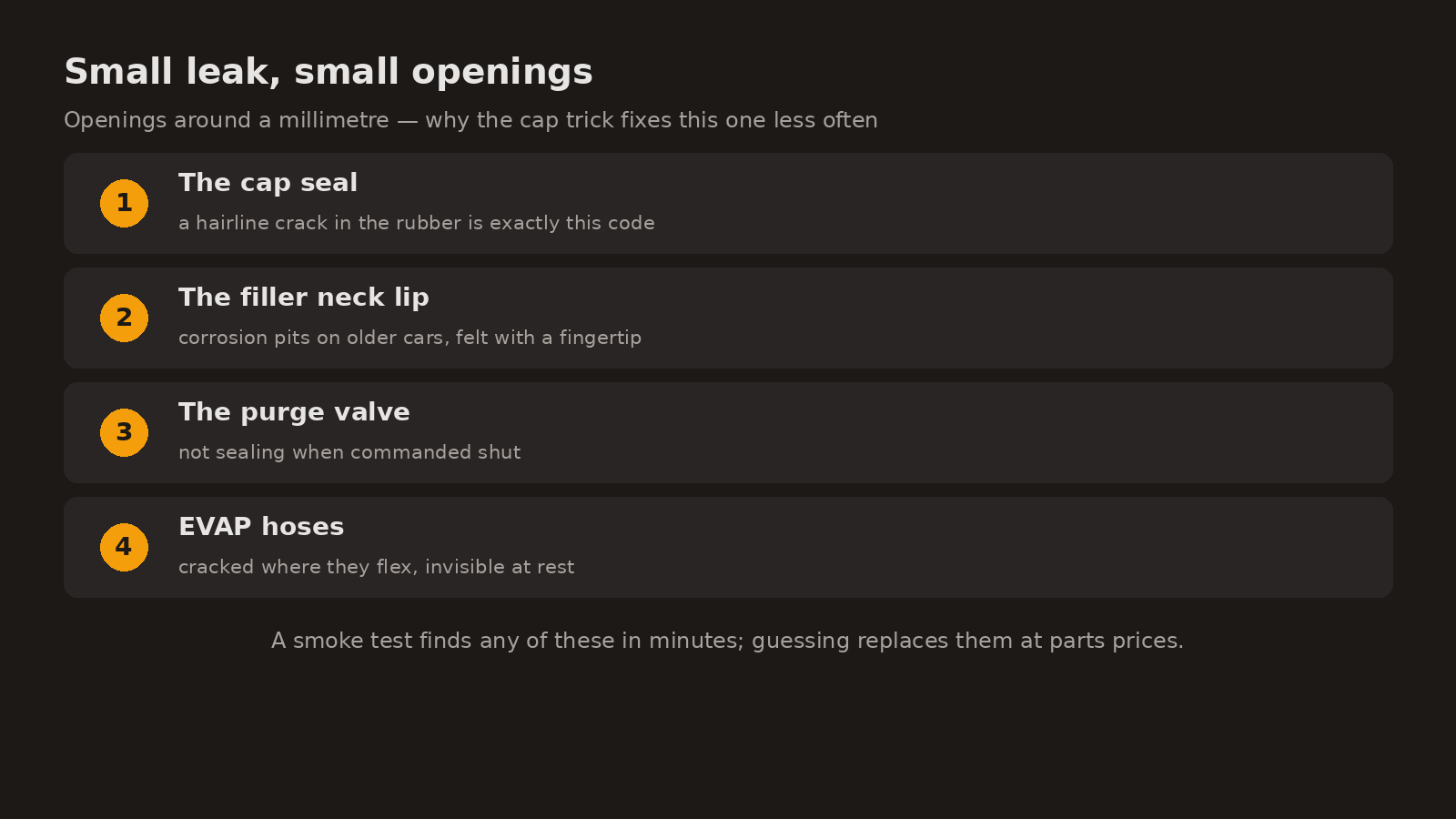
Diagram: the four usual homes of a small EVAP leak — cap seal, filler neck lip, purge valve, and hoses cracked where they bend.
Des informations, pas des instructions
CarGeek est un ouvrage de référence, pas un manuel d'atelier. Ses pages sont rédigées à partir de sources publiques et de ce que d'autres ont constaté, jamais à partir de la documentation technique du constructeur ; elles peuvent donc être erronées ou incomplètes pour votre véhicule précis. Une partie de ce qu'elles décrivent présente un risque réel : haute tension, carburant sous pression, énergie accumulée, pièces chaudes ou en mouvement.
Avant d'agir sur quoi que ce soit, faites-le vérifier par une personne formée, en suivant la procédure du constructeur pour votre véhicule. Rien ici ne remplace cette procédure.