P0420 is rarely the sensor — what the rear O2 is actually saying
So the sensor reporting the failure is usually doing its job, and replacing it usually buys a few weeks until the monitor runs again. Before any parts, two checks:
First, what killed the efficiency. Catalysts rarely die of old age alone — sustained misfires load them with unburned fuel, lean running overheats them, burned oil or coolant coats them. If there is a misfire or fuel-trim code current or in history, fix that first, or the replacement cat inherits the same death.
Second, exhaust leaks ahead of and around the rear sensor. A leaking flange or a cracked flex section pulls in outside air and makes a working cat read as failed.
Then look at the rear O2 live. Flat around 0.6–0.7 V on a warm steady cruise is a healthy catalyst; a rear trace switching in step with the front is the real failure the code describes.
A word on the spacer trick sold everywhere: it moves the sensor out of the exhaust stream so the monitor passes. It does not make the exhaust clean, and it fails the honest version of any inspection.
Pièces jointes
-
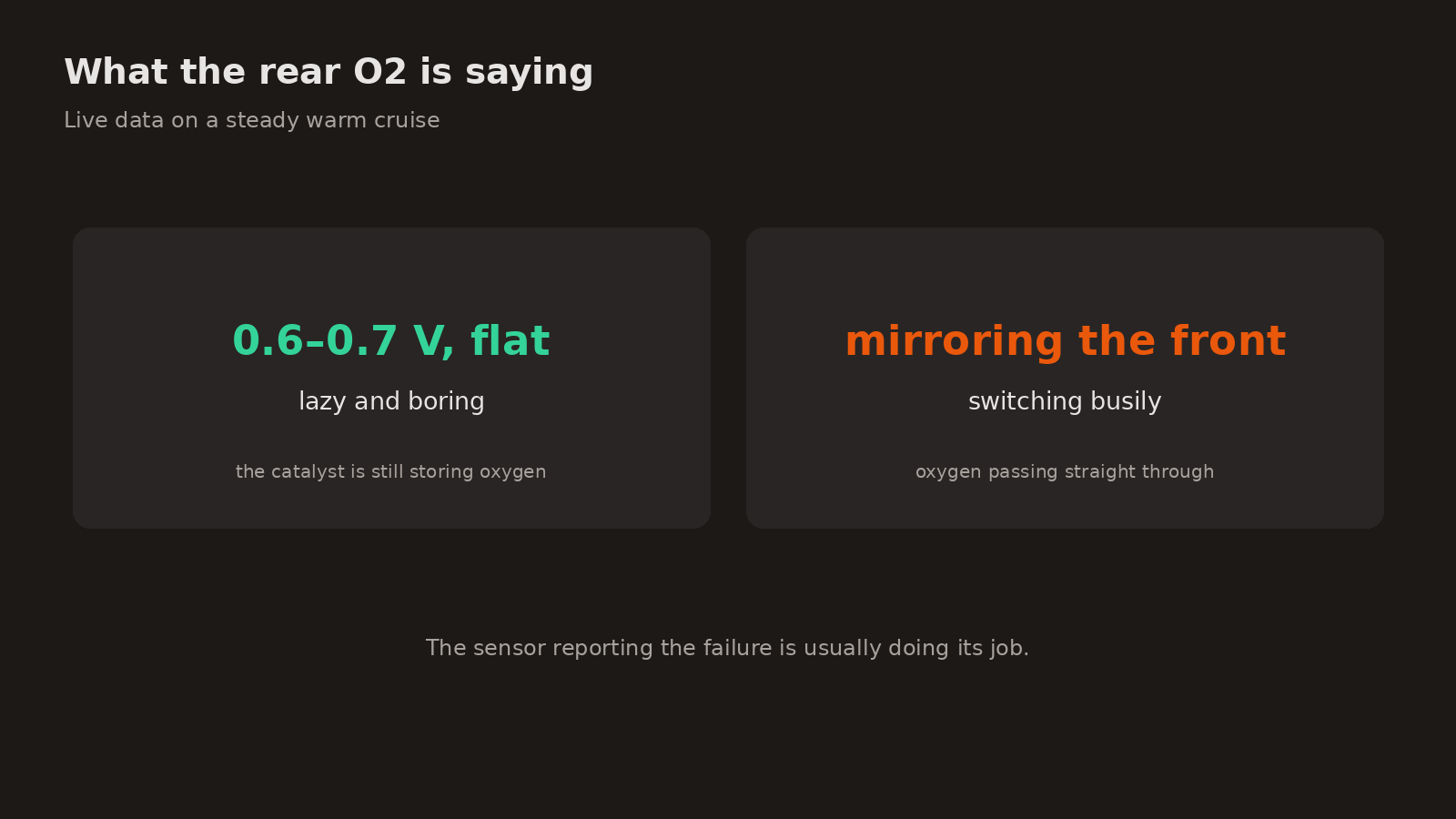
Diagram: a flat rear oxygen sensor trace means a healthy catalyst; one mirroring the front sensor is the real failure P0420 describes.
Des informations, pas des instructions
CarGeek est un ouvrage de référence, pas un manuel d'atelier. Ses pages sont rédigées à partir de sources publiques et de ce que d'autres ont constaté, jamais à partir de la documentation technique du constructeur ; elles peuvent donc être erronées ou incomplètes pour votre véhicule précis. Une partie de ce qu'elles décrivent présente un risque réel : haute tension, carburant sous pression, énergie accumulée, pièces chaudes ou en mouvement.
Avant d'agir sur quoi que ce soit, faites-le vérifier par une personne formée, en suivant la procédure du constructeur pour votre véhicule. Rien ici ne remplace cette procédure.