P0562: when ten codes appear at once, believe this one first
Three measurements tell the story, all at the battery with a basic meter:
Engine off, after the car has sat: 12.4 V or better is a healthy battery at rest. Engine running: 13.5 to 14.7 V says the alternator is charging. Running with load — headlights, rear demister, blower on full: it should hold above roughly 13 V. Sagging into the twelves under load is an alternator on its way out, even though it passed the no-load check.
If the battery reads fine but the code returns, measure the same things again *at the ECU end* or at the underbonnet fuse box. A corroded battery terminal or a failing main ground strap drops voltage between the battery and everything else — the battery tests healthy, the modules starve anyway. Voltage drop across each main cable while cranking should be fractions of a volt; a full volt lost in a cable is the fault.
Slow cranking on cold mornings plus this code is the same story told twice. Batteries fail gradually, then suddenly — and they take a surprising amount of electronics theatre down with them.
Pièces jointes
-
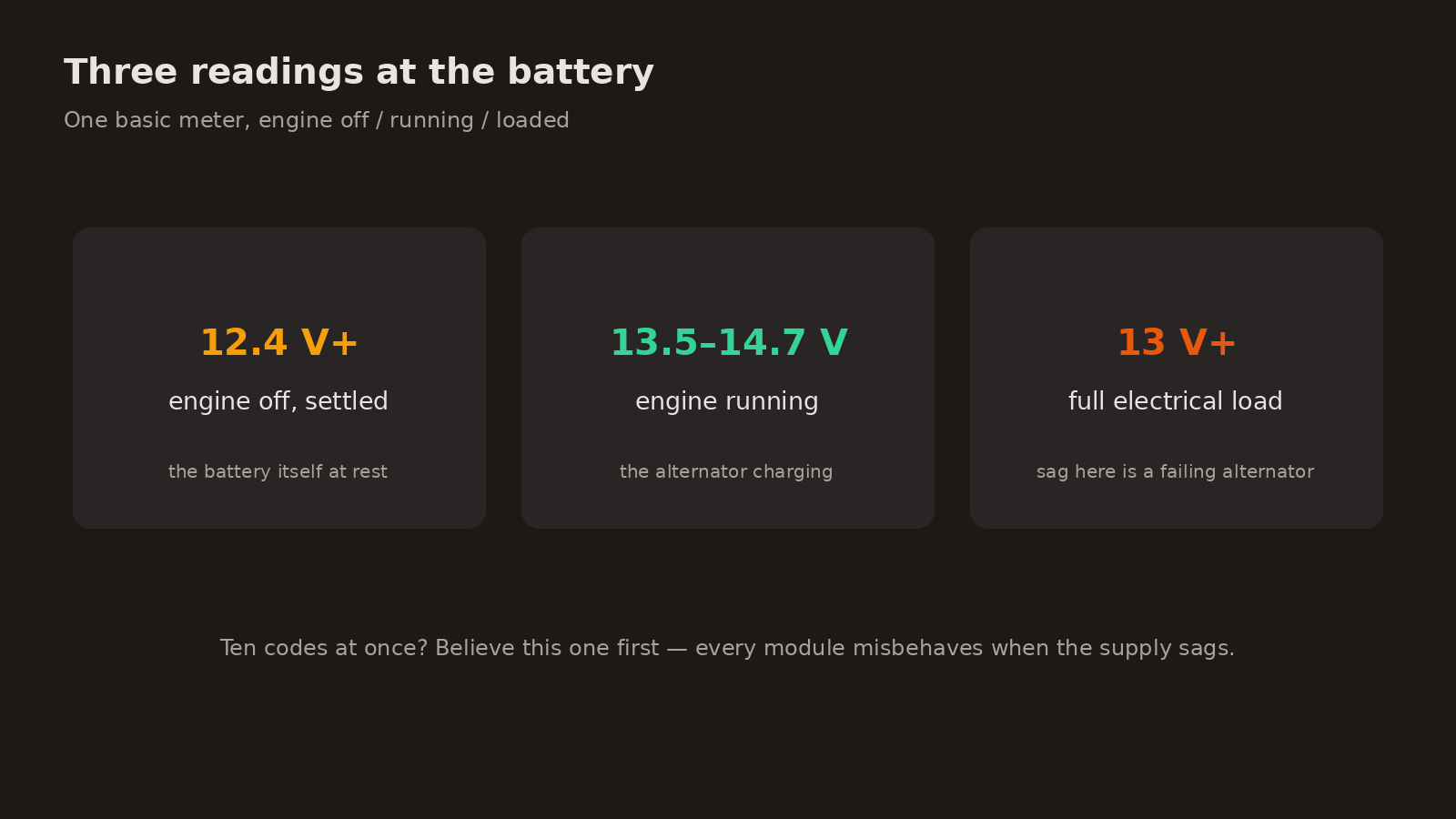
Diagram: the three battery voltage readings that diagnose a system-voltage code — at rest, charging, and under full electrical load.
Des informations, pas des instructions
CarGeek est un ouvrage de référence, pas un manuel d'atelier. Ses pages sont rédigées à partir de sources publiques et de ce que d'autres ont constaté, jamais à partir de la documentation technique du constructeur ; elles peuvent donc être erronées ou incomplètes pour votre véhicule précis. Une partie de ce qu'elles décrivent présente un risque réel : haute tension, carburant sous pression, énergie accumulée, pièces chaudes ou en mouvement.
Avant d'agir sur quoi que ce soit, faites-le vérifier par une personne formée, en suivant la procédure du constructeur pour votre véhicule. Rien ici ne remplace cette procédure.